US Sailing recognizes that the Newport Bermuda Race scoring issue created understandable frustration and confusion among competitors. To provide transparency regarding the Forecast-Time Correction Factor (F-TCF) scoring, we want to clearly explain what occurred, and share the steps we are taking to improve clarity and confidence as we continue advancing offshore sailing in the United States.
The morning the race started, in accordance with the Race Documentation, US Sailing provided the race organizer with F-TCF ratings. The race commenced and was provisionally scored, with those ratings. On Tuesday morning, during the race, a person associated with a group of competing boats called the US Sailing Offshore Office to ask about a large discrepancy in the ratings of two boats that should have rated very similarly. At this point in time, US Sailing began investigating what could have led to that discrepancy.
US Sailing soon discovered that there was an issue with the routing software that was used to calculate the F-TCFs for the fleet. When this realization was made, US Sailing immediately contacted the race organizers and began working with them and other stakeholders on an appropriate remedy.
F-TCF ratings are a combination of predicted performance and the forecasted weather on any given course, and US Sailing uses commonly applied, publicly available software (Expedition) to calculate these ratings.
US Sailing identified two issues that compounded the errors in the original set of ratings provided to the Race Organizer.
The first was when the ratings were produced on Friday morning; for unknown reasons, the software produced incorrect ratings. This error did not occur when the test run was performed on Thursday evening, nor has it been successfully repeated so far while trying to understand the cause.
Despite checks of the ratings being undertaken by US Sailing and the race organizer on Friday morning, the anomalies were not identified; we acknowledge this could have been more robust.
The second issue centered around how the software routes fleets of boats, relative to how it routes boats on an individual basis; running fleets vs. running individual boats produced different ratings. US Sailing worked with the owner of the routing software who subsequently identified and corrected the code error.
Having discovered this, US Sailing then went back and calculated each boat’s F-TCF individually and provided those updated ratings to the race organizer.
Race Organizers choose what rating systems they want to use, and what scoring methods they want to implement. The software that helps calculate those ratings, had a bug, and everyone worked cooperatively and tirelessly to help rectify it. The jury ultimately decides the fate of competitors who seek redress. It was an unfortunate situation for all, and we understand why people feel the way they feel.
The Pacific Cup is using F-TCF; we will work directly with the Pacific Cup to administer and validate the F-TCF ratings for this upcoming race.
Following the Pacific Cup, US Sailing will put a pause on offering to produce F-TCF ratings until we’ve done a thorough review of the process. We realize the integrity of ratings, and the confidence sailors have them, are paramount to fair, safe and enjoyable racing.
FAQs:
- Were Fleet vs. Individually derived F-TCFs different? Yes
- Is the Pacific Cup going to be run under F-TCF? Yes, the OA will continue with F-TCF and are aware of what happened during the Bermuda Race. There are fewer boats, staggered starts, and the calculated TCFs can be compared to a predictable existing course model.
- Does the varied weather on the Bermuda racecourse make it harder to predict and verify relative to TransPac? Yes
- Will US Sailing continue to run Scoring for F-TCF? After honoring our existing commitment to the Pacific Cup, US Sailing will put a pause on F-TCF scoring until we have more information.
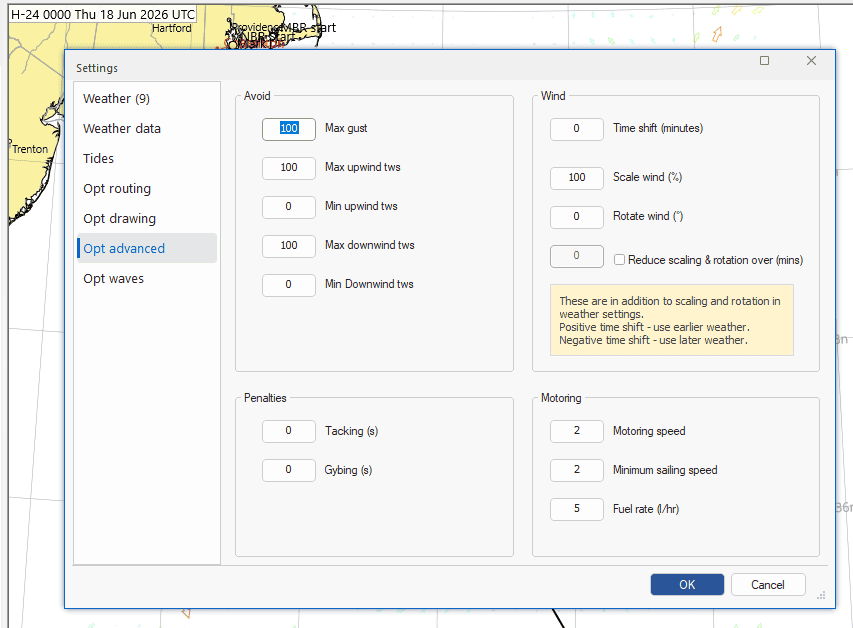
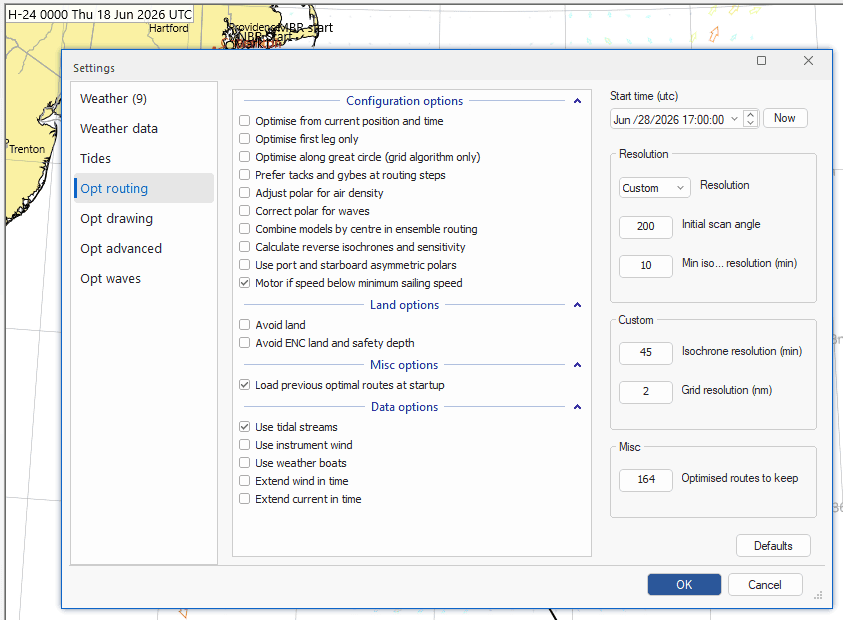
- Q: Why was “Motor if speed below minimum sailing speed” checked in the Expedition optimal routing settings? A: US Sailing calculates the F-TCF for each boat from Expedition’s calculation of the Estimated Time Enroute (ETE), using the designated weather forecast grib files and the ORR polar files. In spite of the fact that the ORR polar files don’t contain speed estimates for wind speeds lower than 4 knots, Expedition extrapolates from the ORR polar speed data for 4 knots of windspeed to 0 boatspeed at 0 knots of windspeed. In tests of F-TCF we’ve observed an anomaly where if a boat’s route happens to arrive at a location with zero wind, then the boat route stops. If the location of that 0 wind point is stationary, which can happen for a while, the ETE increases dramatically which then has a significantly detrimental effect on the TCF. To avoid this problem, we’ve assumed a minimum boatspeed of 2 knots in the computed routes, which nudges the route off of the point of zero wind. Within Expedition the easiest way to implement this is to use Expedition’s “motoring below a threshold speed function. This rarely occurs in the computed routes but it can happen and is worth avoiding.
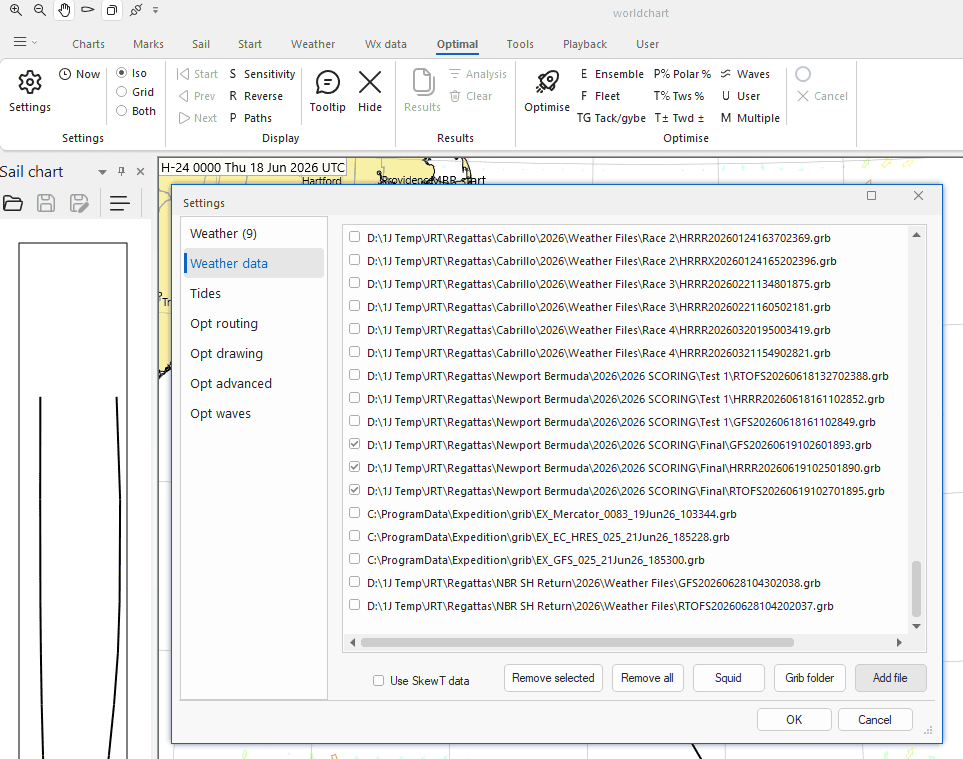
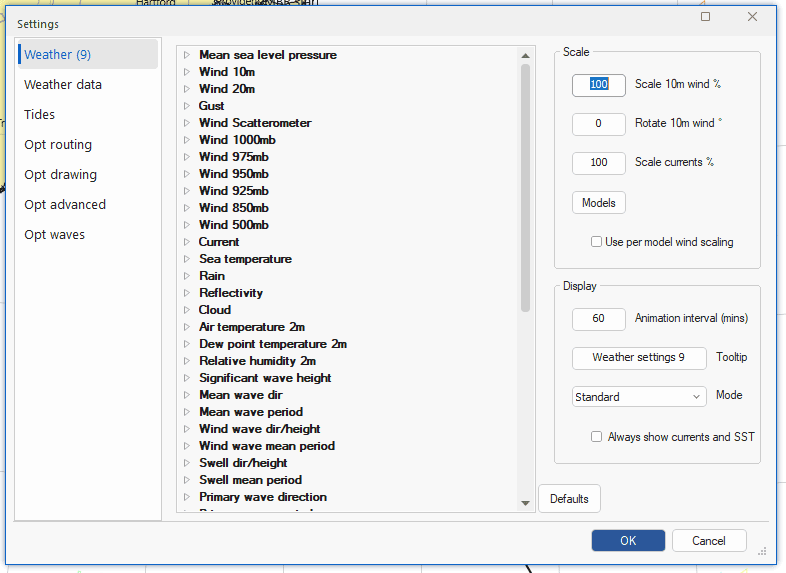
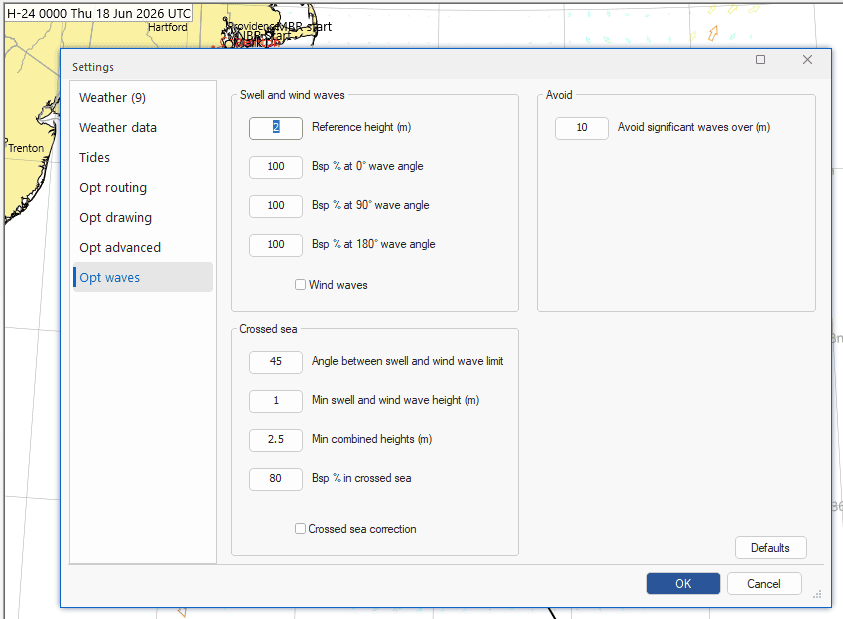
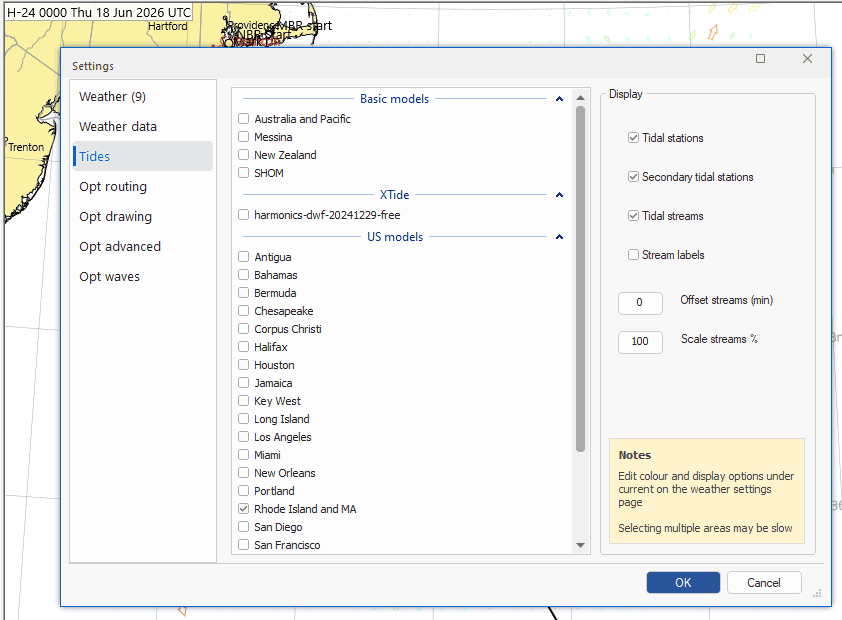
- What were the settings/assumptions used in Expedition for the Bermuda Race routing? See the screenshots below:
-